ID Translation
Turn meaningless IDs into human-readable labels.
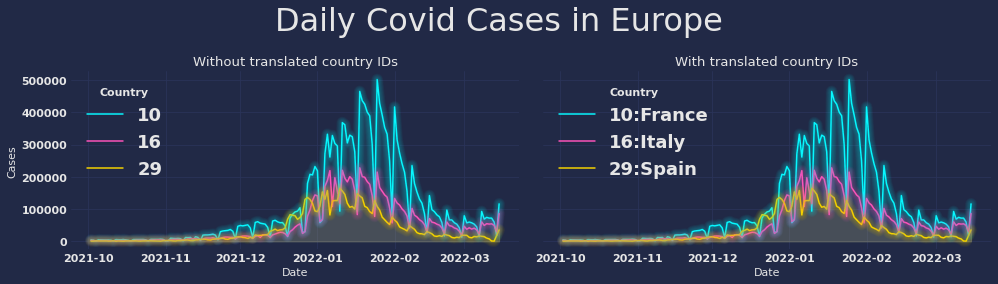
Total number of Covid cases cases per day. IDs have been translated using the standard id:name-format.
The Configuration File
The recommended way of creating and configuring fetchers is the Translator.from_config() method, which takes a YAML config-file and returns a ready-to-run
Translator. The translator has a lot of configuration options, as does its components. See
the Translating with a SQL database notebook and its associated config.yaml file for an example.
Translating IDs in 30 seconds
We will assume that there is a PostgreSQL database running locally with the following two tables present:
humans:                       animals:
   id | name    | Gender        bestie_id | name   | is_nice
------+---------+--------      -----------+--------+---------
 1991 | Richard | Male                  0 | Tarzan | false
 1999 | Sofia   | Female                1 | Morris | true
                                        2 | Simba  | true
- What we need:
A
SqlFetcherto fetch from the tables above.A
Mapperto bind names (such as human_id to table humans) automatically.Some
PlaceholderOverridessince the animals table has a strange ID column.
Putting it all together:
>>> from rics.translation import Translator
>>> from rics.translation.fetching import SqlFetcher
>>> from rics.translation.offline import PlaceholderOverrides
>>> from rics.mapping import Mapper
>>>
>>> fetcher = SqlFetcher(
...     # Connection string may be an environment variable if
...     # prefixed by '@'. Example: @TRANSLATION_DB_CONNECTION_STRING
...     connection_string = 'postgresql://user:passwrod@localhost:5432/mydatabase',
...     whitelist_tables = ['humans', 'animals'],
...     placeholder_overrides=PlaceholderOverrides(source_specific={'animals': {'bestie_id': 'id'}})
... )
>>> mapper=Mapper(score_function='like_database_table', apply_heuristics=True, overrides={"people": "humans"})
>>> translator = Translator(fetcher, fmt='{id}:{name}[, nice={is_nice}]', mapper=mapper)
>>> data = {'animal': [0, 2], 'people': [1991, 1999]}
>>> for key, translated_table in translator.translate(data).items():
...    print(f'Translations for {repr(key)}:')
...    for translated_id in translated_table:
...        print(f'    {repr(translated_id)}') # Doctest: +SKIP
Translations for 'animal':
    '0:Tarzan, nice=False'
    '2:Simba, nice=True'
Translations for 'people':
    '1991:Richard'
    '1999:Sofia'
- Summary:
Database contains tables humans and animals. Names are “animal” and “people”.
PlaceholderOverrides: The ID-column in animals isanimals.bestie_id, we expectedid.Mapper: Responsible for matching animal with table animals. The words “people” and “humans” are too different forlike_database_table(), so we provide this binding.The translator ties it all together when we call
translate().There is no
humans.is_nicecolumn;nice=<True/False>is present only for animals.
The example above could be solved using config options that Translator.from_config() provides. The primary use case for importing and using these classes directly
is writing a more advanced a score_function or fetcher than the implementations of this package provide.