
rics.performance#
Performance testing utility.
Functions
|
Deprecated alias of |
|
Deprecated alias of |
|
Get a summarized view of the best run results for each candidate/data pair. |
|
Plot the results of a performance test. |
|
Run performance tests for multiple candidate methods on collections of test data. |
|
Create a DataFrame from performance run output, adding derived values. |
Classes
|
Performance testing implementation for multiple candidates and data sets. |
- class MultiCaseTimer(candidate_method: dict[str, Callable[[DataType], Any]] | Collection[Callable[[DataType], Any]] | Callable[[DataType], Any], test_data: dict[Hashable, DataType] | Collection[DataType])[source]#
-
Performance testing implementation for multiple candidates and data sets.
For non-dict inputs, string labels will be generated automatically.
- Parameters:
candidate_method – A dict
{label: function}. Alternatively, you may pass a collection of functions or a single function.test_data – A
{label: data}to evaluate candidates on. Alternatively, you may pass a list of data.
- run(time_per_candidate: float = 6.0, repeat: int = 5, number: int | None = None, progress: bool = False) dict[str, dict[Hashable, list[float]]][source]#
Run for all cases.
Note that the test case variant data isn’t included in the expected runtime computation, so increasing the amount of test data variants (at initialization) will reduce the amount of times each candidate is evaluated.
- Parameters:
time_per_candidate – Desired runtime for each repetition per candidate label. Ignored if number is set.
repeat – Number of times to repeat for all candidates per data label.
number – Number of times to execute each test case, per repetition. Compute based on per_case_time_allocation if
None.progress – If
True, display a progress bar. Requiredtqdm.
Examples
If repeat=5 and time_per_candidate=3 for an instance with and 2 candidates, the total runtime will be approximately
5 * 3 * 2 = 30seconds.- Returns:
A dict run_results on the form
{candidate_label: {data_label: [runtime, ...]}}.- Raises:
ValueError – If the total expected runtime exceeds max_expected_runtime.
Notes
Precomputed runtime is inaccurate for functions where a single call are longer than time_per_candidate.
See also
The
timeit.Timerclass which this implementation depends on.
- format_perf_counter(start: float, end: float | None = None) str[source]#
Deprecated alias of
rics.strings.format_perf_counter().
- format_seconds(t: float, *, allow_negative: bool = False) str[source]#
Deprecated alias of
rics.strings.format_seconds().
- get_best(run_results: dict[str, dict[Hashable, list[float]]] | DataFrame, per_candidate: bool = False) DataFrame[source]#
Get a summarized view of the best run results for each candidate/data pair.
- Parameters:
run_results – Output of
rics.performance.MultiCaseTimer.run().per_candidate – If
True, show the best times for all candidate/data pairs. Otherwise, just show the best candidate per data label.
- Returns:
The best (lowest) times for each candidate/data pair.
- plot_run(run_results: dict[str, dict[Hashable, list[float]]] | DataFrame, x: Literal['candidate', 'data'] | None = None, unit: Literal['s', 'ms', 'μs', 'us', 'ns'] | None = None, **kwargs: Any) None[source]#
Plot the results of a performance test.
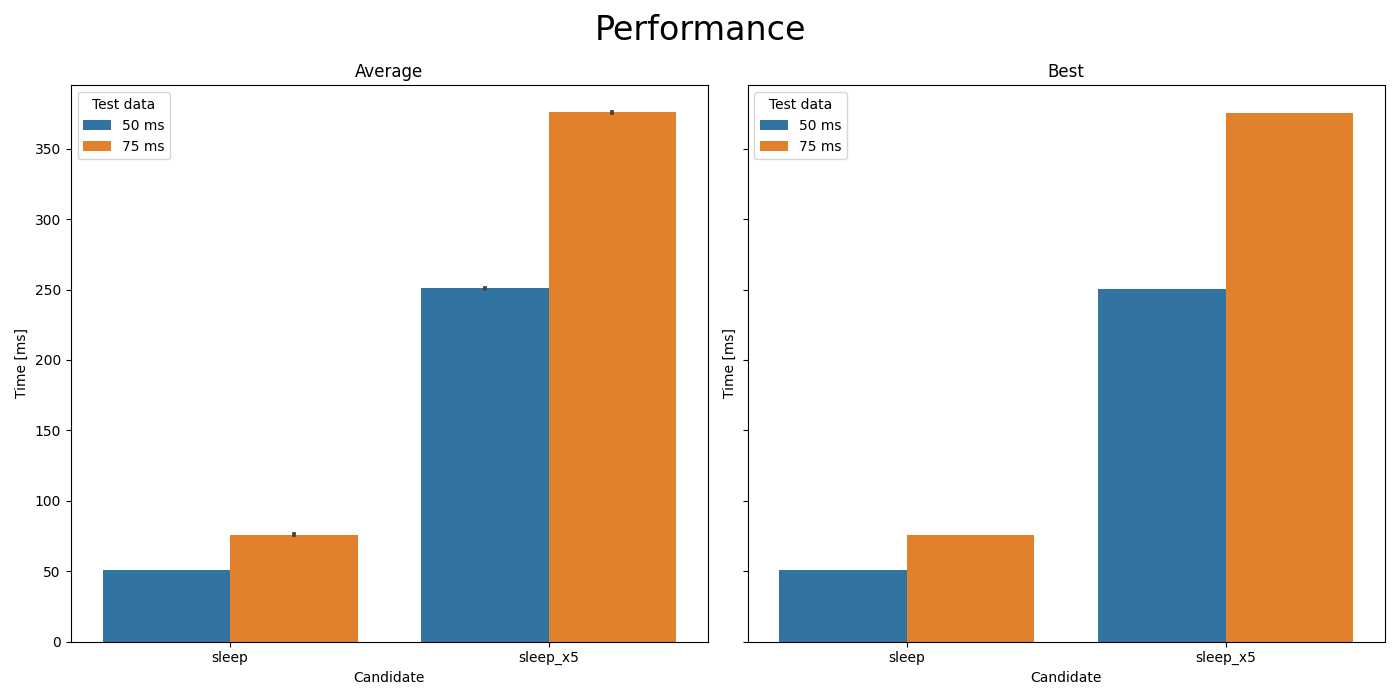
Comparison of
time.sleep(t)andtime.sleep(5*t).#- Parameters:
run_results – Output of
rics.performance.MultiCaseTimer.run().x – The value to plot on the X-axis. Default=derive.
unit – Time unit to plot on the Y-axis. Default=derive.
**kwargs – Keyword arguments for
seaborn.barplot().
- Raises:
ModuleNotFoundError – If Seaborn isn’t installed.
TypeError – For unknown unit arguments.
- run_multivariate_test(candidate_method: dict[str, Callable[[DataType], Any]] | Collection[Callable[[DataType], Any]] | Callable[[DataType], Any], test_data: dict[Hashable, DataType] | Collection[DataType], time_per_candidate: float = 6.0, plot: bool = True, **figure_kwargs: Any) DataFrame[source]#
Run performance tests for multiple candidate methods on collections of test data.
This is a convenience method which combines
MultiCaseTimer.run(),to_dataframe()and – if plotting is enabled –plot_run(). For full functionally these methods should be use directly.- Parameters:
candidate_method – A single method, collection of functions or a dict {label: function} of candidates.
test_data – A single datum, or a dict
{label: data}to evaluate candidates on.time_per_candidate – Desired runtime for each repetition per candidate label.
plot – If
True, plot a figure usingplot_run().**figure_kwargs – Keyword arguments for the :seaborn.barplot`. Ignored if
plot=False.
- Returns:
A long-format DataFrame of results.
- Raises:
ModuleNotFoundError – If Seaborn isn’t installed and
plot=True.
See also
The
plot_run()andget_best()functions.
- to_dataframe(run_results: dict[str, dict[Hashable, list[float]]], names: Iterable[str] = ()) DataFrame[source]#
Create a DataFrame from performance run output, adding derived values.
- Parameters:
run_results – Output from
rics.performance.MultiCaseTimer.run().run_results – A dict run_results on the form
{candidate_label: {data_label: [runtime, ...]}}, returned byrics.performance.MultiCaseTimer.run().names – Categories for keys in the data. If given, all data labels must be tuples of the same length as names.
- Returns:
The run_result input wrapped in a DataFrame.
Modules
Multivariate performance testing from the command line. |
|
Plotting backend for the performance framework. |
|
Types used by the framework. |